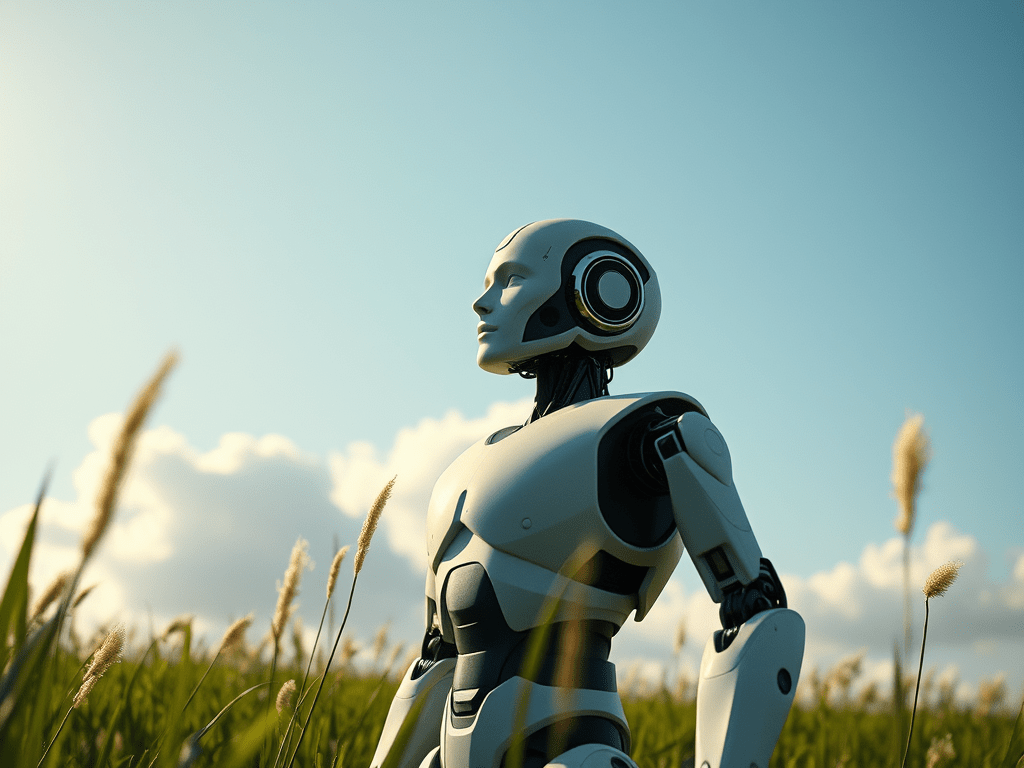
Poetry often helps me make meaning of complicated subjects. In this “Age of AI” (or rather “Age of AI hype”) I keep returning to Joseph Fasano’s poem:
For a Student Who Used AI to Write a Paper
Now I let it fall back
in the grasses.
I hear you. I know
this life is hard now.
I know your days are precious
on this earth.
But what are you trying
to be free of?
The living? The miraculous
task of it?
Love is for the ones who love the work.
This question of ‘what are we trying to be free of?’ is the central question for me. It seems that the dominant narrative, echoed by endless technology companies “integrating AI,” is that there is much I should want to be free of. That the answer to the problem of living lives in whatever ChatGPT or Gemini can produce for me. Never mind the environmental cost, the human cost, the loss of art and beauty. Our Amazon warehouses of full of humans doing robot work, while the robots are writing poetry.
This morning Maria Popova’s “The Marginalian” weekly dispatch hit my inbox, and it connects to this idea of freedom, of making meaning. She writes:
Meaning is not something we find–it is something we make, and the puzzle pieces are often the fragments of our shattered hopes and dreams. “There is no love of life without despair of life,” Albert Camus wrote between two World Wars. The transmutation of despair into love is what we call meaning. It is an active, searching process–a creative act.”
I wonder about what happens for our students when we prevent them from making meaning. But I don’t see GenAI as the major barrier to preventing students from finding their own way towards meaning, rather it is the gatekeeping we do around meaning making. In ELA classrooms across this county, students are slogging their way through novels, guessing at symbols and metaphors that are horded like jewels by their teachers. Why are we doing this? Our standards don’t even call for these outdated exercises in futility. With so many student-centered, inquiry based teaching resources in the world (see PBLWorks.org, Workshop approaches, Universal Design for Learning), the iron grip we keep on whole class novels followed by writing a “literary analysis” is baffling to me.
What we urgently need is critical literacy for interpreting our current landscape of multi-modal texts. If our next generation is going to have a hope of overcoming the tsunami of AI-generated propaganda and social media schlock inundating them on a regular basis, we need to collectively investigate best practices for consuming this content, lest we fall prey to believing something against our best interests. It happens to everyone: some piece of propaganda comes across our feed from a friend or colleague, and we want to believe.
I suppose all of this is work, and the promise of GenAI is to free us from work. But what are we doing with our extra free time? How are we supporting our young people who are constantly interrupted by the constant pings of their devices? Are we being freed to only become imprisoned by our choice to scroll for hours? What is this promise of freedom?
I’m still thinking about all of this, trying to make my own meaning. This is moment of uncertainty, of sensing that so much of the work of this age is navigating this uncertainty (shoutout to Dave Cormier).


 Hey Human
Leave a comment